
Protecting Land, Strengthening Communities
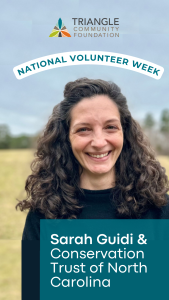 This National Volunteer Week, we're going Beyond the Job to spotlight colleagues who are making an impact in the community outside of their day-to-day roles. From board service to hands-on volunteering, these stories reflect the many ways we can all make more possible for our community.
This story highlights a Q&A with Sarah Guidi, Director of Community Engagement at the Foundation, and her service with Conservation Trust of North Carolina.
-
What nonprofit(s) are you involved with?
I serve on the Board of Directors for the Conservation Trust of North Carolina (CTNC). Their mission is to conserve land across the state of North Carolina in ways that build resilient, just communities.
-
How did you first get connected?
I first learned about CTNC when I was on staff at The Conservation Fund, and stayed updated on their work given my experience with the Environmental Resilience grant program at Triangle Community Foundation. A few years ago, Lori O’Keefe, President and CEO of the Foundation reconnected me more intentionally. The former board chair of the Conservation Trust, Brandon Robinson, had reached out to Lori asking for board member recommendations, and knowing my background in environmental conservation and that I was seeking professional growth and development opportunities, she recommended me to Brandon and the Board agreed to bring me on board!
-
Why does this cause matter to you? What sparked your interest/passion for serving at this organization?
I am a social worker by training - I received my master's degree in social work at UNC Chapel Hill and unexpectedly found myself working with an environmental conservation organization, post-graduation called The Conservation Fund. I didn't expect social workers to really thrive in that space, but the role of a social worker is to really look at individuals in the context of the various systems they operate in. Land, the literal physical place where we spend time in our homes and in our communities, is such an important part of the environments that we live in. I ended up staying in the conservation and land use planning space throughout my early nonprofit career before coming to Triangle Community Foundation.
Although I do some work with environmental conservation at the Foundation, being able to be on a board that is looking at conservation across the state of North Carolina with a resilience and justice orientation was something I was really drawn to. That tangential understanding of land conservation combined with my philanthropic and nonprofit experience made CTNC a really intriguing organization from a professional standpoint.
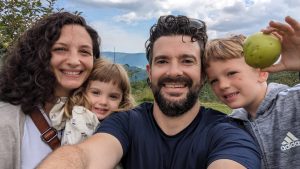
From a personal standpoint, what really solidified the decision to be involved with this organization is finding out that CTNC holds a conservation easement for the Orchard at Altapass, a nonprofit apple orchard in Spruce Pine, NC that my family and I visit every year. When I saw this on CTNC’s website it really resonated with me that land conservation can play such an important role in community. Conserving land so that we have green spaces is good for the environment, ecosystems, and habitat, and it's also really good for people and local economies.
-
What does your involvement look like (board, committee, mentor, event volunteer, etc.)? What’s the time commitment like?
I accepted the board role in late 2024 and CTNC had an orientation in March of 2025, which was a really beautiful way to bring on new board members so we could meet the more veteran members and also the staff. There are quarterly board meetings that are in-person across North Carolina since it is a statewide organization. CTNC holds their annual signature event in the Blue Ridge Mountains which combines donor engagement and appreciation with a board meeting. I experienced my first one this past August, and it was really moving to be in the place that your organization has helped make possible. In the organization's history, they have helped conserve over 37,000 acres of land with a lot of that near and on the Blue Ridge Parkway.
I have also served on a couple of committees at CTNC including the nominating committee to help bring aboard new board members, strategic planning committee, and I also support the community engagement committee, which is evolving as the strategic plan is bringing us into new directions.
-
What has surprised you about serving?
A couple of key observations.
- Even though I've worked with a lot of nonprofits, I sometimes feel a level of imposter syndrome particularly in the environmental and land conservation worlds. There are so many technicalities in this work. From the real estate transactions with lawyers involved to mapping - those are not my skills. However, I've been surprised at how I've been able to participate in guiding the direction of the organization.
- Even though I've worked in nonprofits my entire career, this is the first board that I’ve served on! I've always been on staff, preparing board materials and helping to facilitate and present in meetings, so it's a really humbling opportunity to have had all of that experience before serving on a board myself. I'm often surprised at how enriching it is for me as someone who supports a lot of nonprofits in the Triangle in a grantmaker capacity.
-
What would you say to someone who thinks they “don’t have enough time”?
All nonprofit board members have three main fiduciary responsibilities (duty of care, duty of loyalty, and duty of obedience) to the organization, and so I would encourage someone to fully understand your responsibilities. More practically, understanding other expectations of board service, including the time commitment, so that you can be honest with yourself if you have the bandwidth. If you decide that you can’t commit to board service right now, that’s okay! There are plenty of other ways to get involved with an organization, from serving on a committee or volunteering or becoming a financial donor. I think understanding their needs and expectations and being honest with yourself if you have the time to dedicate and the right skills is crucial.