Building a Culture of Philanthropy: A Conversation with NCCU’s Josiah Russell
As Homecoming Weekend approaches this weekend for North Carolina Central University (NCCU), it’s a fitting time to reflect on the relationships and connections forged at Historically Black Colleges and Universities (HBCUs) and the collective investment that helps sustain their impact for generations to come. Triangle Community Foundation is proud to be part of that legacy through its partnership with NCCU, which has provided more than $450,000 in scholarships since 2009.
To explore the role philanthropy plays in strengthening institutions, empowering students, and advancing communities, we spoke with NCCU alumnus and Associate Director of Annual Giving Josiah Russell about his journey into advancement, the importance of cultivating a culture of philanthropy, and what meaningful partnership looks like between higher education institutions, funders, and the communities they serve.
How did your undergraduate experience at NCCU lead to your current role at the institution?
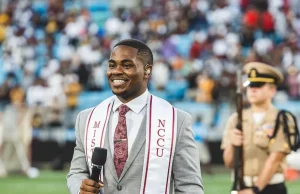
I studied mass communications, with a concentration in public relations. I had a minor in business, having started out as a business administration major. I switched because I had a creative itch I needed to scratch. I was heavily involved on campus and a lot of different student organizations, including serving as Mr. NCCU, the student representative for the university. Those experiences really taught me how powerful relationships are – true authentic relationships, that aren't merely transactional. It taught me the value of service beyond the academic requirement at NCCU.
One reason I work in advancement now is because I am a literal example of how philanthropic dollars can transform a student experience. When I was Mr. NCCU, the associate vice chancellor at the time bought me my first suit and pair of dress shoes, which I needed to represent the university in an honorable fashion.
 What are some of the most important lessons you’ve observed in the relationship between institutional advancement/development and philanthropy?
I would say fundraising and philanthropy are not the same. People have fundraisers all the time. And my director likes to say, “You can't fish fry your way to prosperity, right?” Selling hot dogs and popcorn are great fundraising efforts. But I think philanthropy is more of a culture - it's embedded and an identity. If something is part of who you are, it's a pattern and it's recurring. I believe people rarely give to something because an institution asks them for money, they give because they understand the impact and they trust the organization. We also don't talk enough about how important stewardship is. If someone doesn't feel valued for their sacrifice or their contribution, it's kind of hard to explain to them the next fiscal year why they should give again. If they aren't seeing stewardship and how the money made a difference on a campus or in an organization then what is the reason to give again?
How have you tried to take the lessons you’ve learned and build a culture of philanthropy among students?
Particularly for students, I try to explain to them that philanthropy is not just about money. I try to use different language and not talk a lot about money, but more so their time and their talents. Because for students, the biggest commodity they have right now is their time, which in my opinion, is a greater commodity than money because you can get money back. You can't get your time back. The amount of time they're invested in the community through NCCU is remarkable.
Has the current state of federal funding for academic institutions impacted NCCU? If so in what ways?
Universities like NCCU serve through scholarships, academic programs, research, student support services, and a plethora of other things, specifically because they support career development at the university. So, when external funding environments become a little bit less predictable, that should reinforce private philanthropy, corporate partnerships, foundations, alumni, community partners, to become even more engaged in helping institutions respond to emerging needs. I also think that unpredictability challenges us in advancement to communicate those needs effectively. And to be more intentional about our communication and internal partnerships at the university to be connected instead of working in silos.
What are some of your strategic initiatives to adapt to current forms of communication and the current state of philanthropy?
The biggest strategy has been applying marketing and consumer behavior principles to philanthropy. The way people communicate, consume information, and build relationships with organizations has dramatically changed, and advancement must evolve with that. Long solicitations are a thing of the past for younger generations, and capturing students earlier through channels like digital storytelling is huge. When thinking back to a consumer behavior perspective, if we wait until they’re young alumni, it's too late. We have students on campus, ideally, from their freshman year to their senior year. There should be times of philanthropic education and identity sourcing inside of their experience as a student. This is who we are as a culture, as Eagles, and this is why we do it.
Personalized donor communications, experiential engagement, and segmentation are very important also. You can't communicate the same way with someone who's given you $50,000 and someone else who's given $500. The level of stewardship requires a different intentional touch.
What can community members and funders do to learn more about and support NCCU and HBCUs, in general?
Get closer to the institution and get connected with your alumni networks. That's the real reason I think we come to school - to be connected. It unifies us under one shared identity. Meet the students, talk to the faculty and staff, attend programs, learn about the research, community engagement, and initiatives that may be happening beyond what we see publicly.
For funders specifically, I would encourage them to approach HBCUs as a strategic partner, not just as recipients of philanthropy. Ask institutions what their priorities are, rather than giving them a predetermined one-size-fits-all solution. There are so many different opportunities to provide support, from student success to research, innovation, career development, scholarships, and more. I think the most meaningful partnerships happen when we ask both sides, “What are we uniquely positioned to accomplish together?” Because I don't think it should ever feel transactional - I think it's a mutually beneficial experience.