Triangle Impact Fund I: Housing Affordability
Application Deadline
July 13, 2026
Amount
In this first Request for Proposals (RFP), we expect to deploy up to $4,400,000 via loans to eligible applicants to support specific projects in the Triangle that advance one of three key pillars related to housing affordability. Typical investments will range between $250,000 and $1,500,000 per project.
Application Open
Monday, June 15, 2026
Program Overview
Housing affordability is a critical issue in the Triangle region, impacting both individuals and the overall economic health of the area. Recent population growth and related surge in demand has driven up housing prices dramatically, making it increasingly challenging for many to find affordable places to live. This lack of affordability especially affects essential workers like teachers, service industry employees, and young professionals, potentially forcing them to commute long distances or even leave the area, impacting the region’s workforce and overall quality of life.
Triangle Community Foundation seeks to leverage its unique assets to make an impact on housing affordability in the Triangle. We are pleased to formally launch the Triangle Impact Fund (the Fund).
The Fund is an impact investment initiative of the Foundation designed to deploy below-market capital to support projects that advance long-term housing affordability for low- and moderate-income households while strengthening community stability and preventing displacement.
| Interest Rate | Below market rate. Based on borrower capacity, community benefit, and other criteria included in the evaluation framework. |
| Term | Up to five years. |
| Fees | No origination fee. |
| Security | Secured or Unsecured. We will seek collateral where feasible. While not all loans will be fully collateralized, risk mitigation is required in every transaction. |
| Reporting | Borrowers will be required to provide periodic financial and impact reporting, notify the Foundation of material changes to the project, financing, or organization, and maintain compliance with loan covenants. |
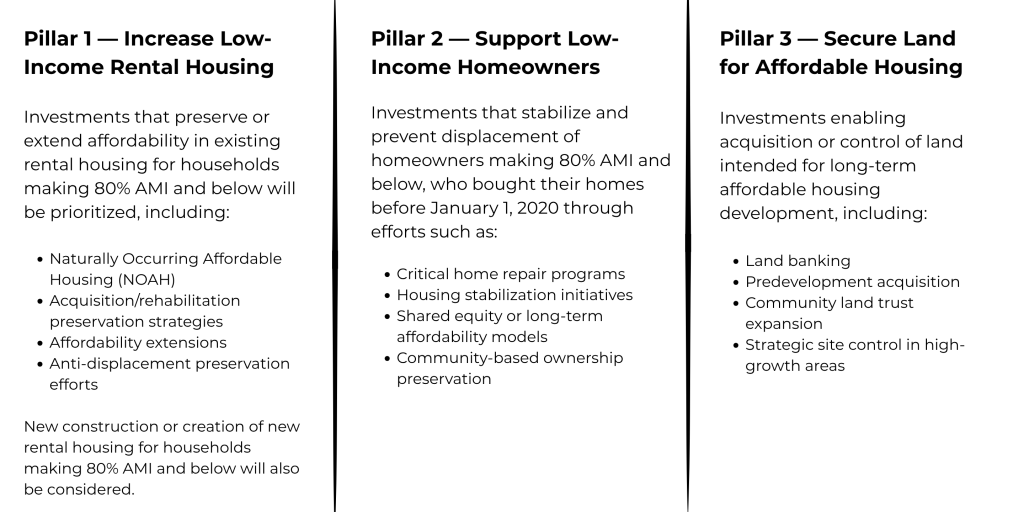
Program Goals: Our Housing Pillars
Projects must align with one primary funding pillar.
Eligibility
All applicants and projects must meet the following eligibility criteria. Those that do not will not be fully reviewed and scored.
- Applicants must be one of the following:
- Nonprofit housing organization
- Mission-driven developer (for-profit, not-for-profit, or B Corporations)
- Community development organization
- Partnership including affordable housing developers and/or local governments
- Local governments are not eligible to be the primary applicant
- Projects must:
- Be located within the Triangle region (Chatham, Durham, Orange, or Wake counties)
- Align with one or more housing pillars
- Demonstrate site control or program readiness
- Show a defined financing gap
- Commit to long-term affordability outcomes
- Demonstrate implementation capacity
- Outline a clear repayment plan within five years
- Capital use: Funding will be deployed as below-market loans to support costs including, but not limited to:
- Acquisition financing
- Gap financing
- Pre-development costs
- Preservation transactions
- Homeowner stabilization programs
- Land acquisition or holding costs
Evaluation Process
Applications are reviewed through a three-stage process:
- Stage 1 — Threshold Review (Pass/Fail)
Eligibility verification by Foundation team.
- Stage 2 — Quantitative Scoring (100 Points)
Projects evaluated based on:
| Category | Points |
| Mission & Pillar Alignment | 10 |
| Financial Feasibility | 10 |
| Project Readiness | 10 |
| Affordability Impact | 10 |
| Organizational Capacity | 10 |
| Pillar-Specific Impact | 30 |
| Innovation & Ancillary Benefits | 10 |
| Committee Discretion | 10 |
| TOTAL | 100 |
- Stage 3 — Impact Investment Committee Decision
Projects receive one outcome:
- Fund
- Hold
- Decline
All decisions will include written rationale.
Evaluation Criteria and Scoring Methodology
All eligible applications will be evaluated using a 100-point scoring framework. The following criteria describe how projects will be assessed and what applicants should address in their submission. Please click here to review the evaluation and scoring details.
Timeline
| Milestone | Date |
| RFP Release | Monday, June 15, 2026 |
| Information Session | Monday, June 22, 2026 |
| Applications Due | Monday, July 13, 2026 |
| Review Period | Late July – early August 2026 |
| Underwriting and Committee Decisions | August – September 2026 |
| Public Award Announcements | By Thursday, September 17, 2026 |
Required Application Materials
Applicants must submit via Triangle Community Foundation’s Grant Lifecycle Management Platform:
- Completed Application Response
- Development budget or program budget
- Sources and uses
- Organizational financials (last three years)
- Development or program experience
- Site control documentation (if applicable)
- Affordability commitment description
Information Session Registration
A virtual information session will be held on Monday, June 22, 2026 at 1:00pm EDT via Zoom. Registration is required: https://trianglecf-org.zoom.us/meeting/register/FEsQxxKYRqiempNRjDBYnA
Reporting Expectations
Awardees will report outcomes on an annual basis. Metrics will be aligned with the Triangle Impact Fund Impact Indicators Framework, including:
- Units preserved or created
- Homeowners stabilized
- Land secured for affordability
- Households served
To Apply
To be considered for funding, applicants must submit an application using Triangle Community Foundation’s Grant Lifecycle Manager (GLM) platform: https://www.grantinterface.com/Home/Logon?urlkey=trianglecf
All required materials must be submitted by 11:59pm on Monday, July 13, 2026 via GLM. Responses submitted after this deadline or outside of the GLM platform will not be considered.
Applicants should submit any questions related to this RFP to Sarah Guidi, Director of Community Engagement, 919-328-4014, or [email protected].